Ask any job seeker what applying for jobs feels like. You’ll hear the s ame words over and over: black hole, ghosting, frustrating, demoralizing.
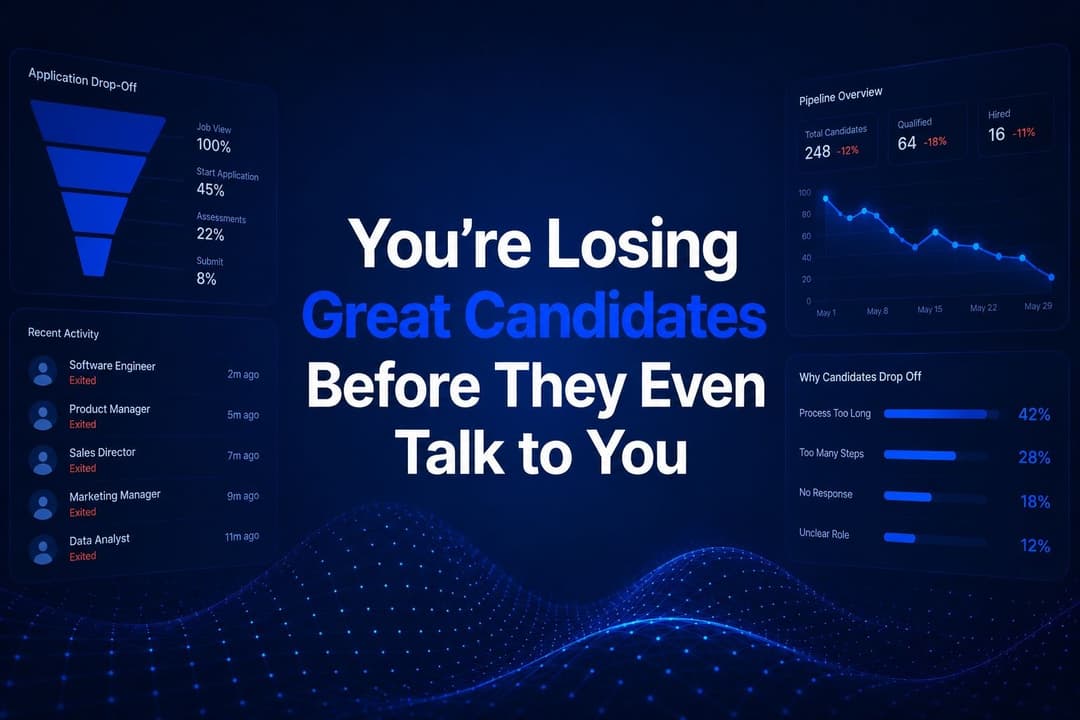
They’re not wrong. And while it’s easy to write this off as candidate perception, the data tells a more uncomfortable story: a poor application experience is actively filtering out your best candidates.
🕳️ The Black Hole Effect
Here’s what the typical candidate journey looks like on a legacy platform:
- Find a job posting
- Fill out a lengthy application form, often re-entering information already on their resume
- Submit and receive an auto-confirmation email
- Wait
- Receive an automated rejection 3 days later, or hear nothing at all
This is the experience your company is currently delivering to every person who wants to work for you.
The candidates who accept this process and keep applying anyway? They’re often the ones who are most desperate for any job, not necessarily the best fit. The candidates who bail? Frequently the ones with options - which, by definition, includes your strongest prospects.
Bad candidate experience is a self-selecting filter for mediocre hires.
📊 What “Candidate Experience” Actually Costs You
This isn’t a soft HR metric. The business impact is concrete:
- Offer rejection rates rise when candidates have had a cold, impersonal experience through your funnel - even when they want the role
- Your employer brand suffers when rejected candidates share their experience publicly (Glassdoor and LinkedIn make this frictionless)
- Qualified candidates self-select out before completing long, repetitive application forms
- Time-to-fill extends when your pipeline is thin because the application experience discouraged volume from the start
Companies that compete on talent can’t afford to ignore any of these.
✅ What a Good Candidate Experience Actually Requires
Most ATS platforms make it nearly impossible to achieve all of these:
Transparency. Candidates should know where they are in the process at all times. Not a vague “under review” status actually visible in your hiring stages, timelines, and next steps.
Respect for their time. Apply once, not repeatedly. A candidate who has already submitted their information shouldn’t be asked to re-enter it for every application. Their profile should carry over.
Speed. The best candidates are fielding multiple conversations. A slow, manual, multi-week process will lose them to a company that moved faster.
Communication. Ghosting candidates is the fastest way to destroy your employer brand and ensure they never apply again or recommend your company to anyone they know.
🔁 How SCALIS Approaches Candidate Experience
We designed SCALIS around the candidate as much as the employer, because we believe those two things aren’t in tension. A great candidate experience produces better hiring outcomes.
On SCALIS, candidates fill out their profile once. That profile travels with them across every employer using the platform and auto-updated when they update their resume, auto-populated on new applications. No repetitive forms.
They get real visibility into the hiring process through application dashboards, what stage they’re in and what’s coming next. They receive timely, automated communication at every stage. And they’re not just passively waiting to be found: our matching engine invites high-fit candidates to apply to roles they might not have discovered otherwise.
The result is a pipeline where candidates are engaged, informed, and invested, not frustrated into dropping out.
💡 The Employer Upside
Companies with strong candidate experience fill roles faster, receive more applicants (because word spreads), and see higher offer acceptance rates. The investment in the experience pays back in pipeline quality and speed.
On SCALIS, the infrastructure to deliver that experience is built in.
Your candidates deserve better. And so does your hiring pipeline.
👉 Book a SCALIS demo and see how a candidate-first platform changes your results.